
Need assistance?
Need Assistance? Call Us 0330 058 0630
08/01/2026 • by Alice P

When it comes to designing or upgrading a fire alarm system, one of the first decisions you will face is whether to use addressable or conventional wiring. These are two of the most used types of wiring. Of course there are others, such as wireless and bi-wire.
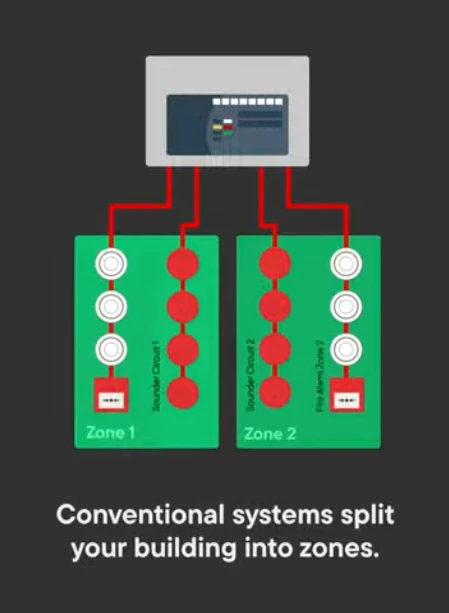
Conventional systems divide a building into zones. Each zone is wired separately back to the fire alarm control panel. Devices within the same zone share a circuit.
If a detector activates, the panel tells you which zone is in alarm, not which specific device. For example, you may know the alarm is coming from “Zone 3 – First Floor Offices,” but you will still need to investigate to find the exact detector or call point.
Each zone has its own dedicated cable run.
Multiple devices share the same circuit.
The panel reports alarms and faults by zone, not by device.
System logic is relatively simple.
Conventional systems are commonly used in smaller buildings, such as a small coffee shop, where zones are easy to manage and rapid pinpointing of a single device is less critical.
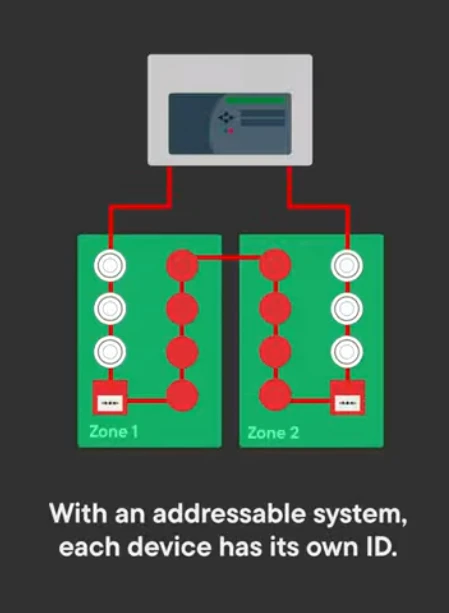
Addressable systems work differently. All devices are connected on one or more loops, and each device has a unique address. The control panel communicates individually with every detector, call point, and module.
When an alarm occurs, the panel can tell you exactly which device has been triggered and where it is located.
Devices are connected on loops rather than individual zone circuits.
Each device has a unique digital address.
The panel reports the exact device in alarm or fault.
Advanced cause and effect programming is possible.
Addressable systems are typically used in larger or more complex buildings where clarity, control, and flexibility are important.
When deciding which system is appropriate, the starting point should always be the fire risk assessment.
A competent Fire Risk Assessment identifies the level of risk within a building, how a fire could develop, how people would be alerted, and what level of system performance is required.
In many cases, the outcome of the assessment will strongly influence whether a conventional or addressable system is suitable, particularly in buildings with complex layouts, vulnerable occupants, or higher life risk.
If you’re in need of a professional fire alarm system, our technical team can help you make the right decision.


